Story: Athar Abu Samra
Edited and translated by: The MENA Archival Lab
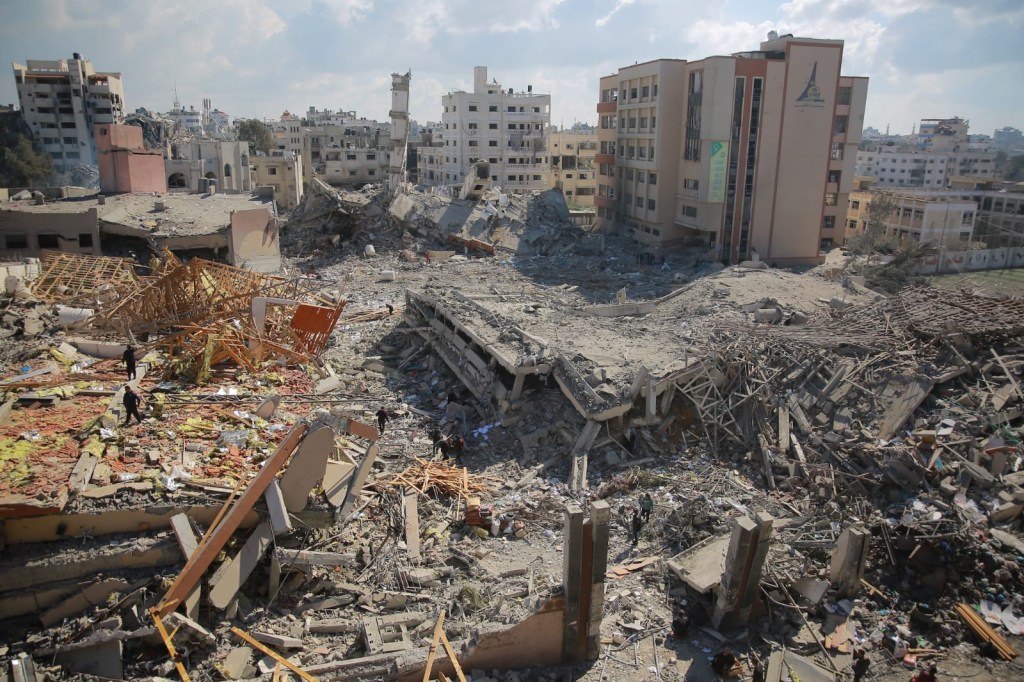
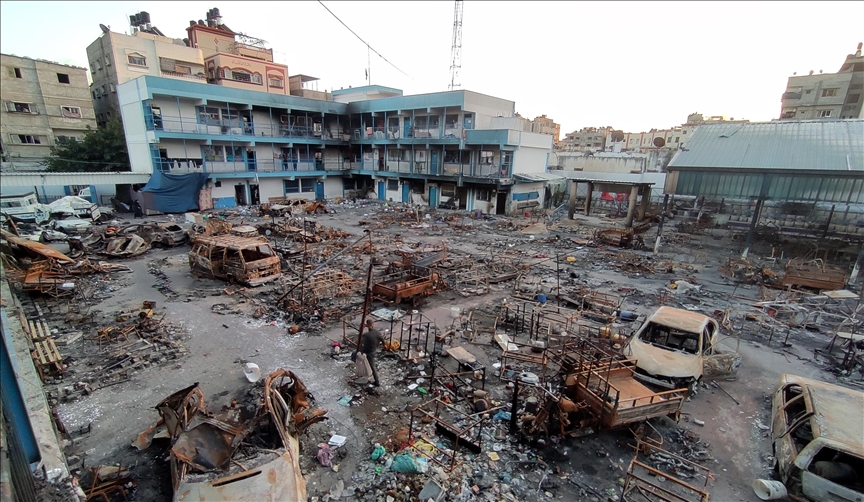
As schools all around the world kick off their academic year, children in Gaza are left behind yet once again, for the second year in a row. While over 80% of the city remains under rubble, thousands of Gazans are deprived of access to any form of learning. From empty seats to disoriented students caught between the weights of displacement and the unknown, what once characterized the typical school semester has become distorted through the turmoil of war – unrecognized. Since the war awoke on October 7th, Gaza’s entire educational infrastructure became completely torn apart. Kindergarten spaces were completely decimated, university buildings relentlessly bombed, and UN schools such Al Bureij turned into shelters for the displaced. Other schools across the Strip went completely out of service due to mass displacement of its students and staff. Consequently, in light of continuous bombing by the Israeli forces and the obliteration of any suitable infrastructure, Gaza has come to lack a safe learning ecosystem where students can exercise their right to learn and attend classes as they normally would. Nowadays in Gaza, education has unfortunately become a luxury many can barely afford or reach in the shadow of an ongoing humanitarian catastrophe like no other.
Two years of war: a generation’s education buried beneath the rubble?
“While students all over the world continue to take their exams, we’re sat in a tent – and we feel otherworldly; like we don’t share the same planet. I’m one of the students who was supposed to pass this year and go to college – but the war deprived me and many of us, of any moments of success or joy”.
These excerpts merely sum up a staggering feeling shared from several Gazan students – rippling through an entire generation. A generation trapped under rubble and bound by fear, forgotten under ruins – no certificates, no ceremonies, and no clear horizon of a promising future. As we see graduation photos from neighboring countries flooding social media, the children of Gaza spend the very little breath they have left trying to save their book remains from their homes – turned into smithereens. They hold onto the same units they studied two years ago since the war, going over the same subjects, stuck in the same loop and holding onto a hope that becomes more distant day by day.
Imposed illiteracy: When childhood is erased before it is written
Between one displacement tent to the other, children in Gaza grow older in isolation from the most basic components of education and childhood. They move about their lives without learning their alphabet, in the absence of kindergarten spaces, stories or even the slim chance of learning the essentials of writing. One mother in Gaza reported the following:
“My son turned 5 years old and still does not know the alphabets, and doesn’t have any toys to play with or teachers to look up to. He doesn’t even have the chance to memorize his own name.”
This is not just an individual case; but an entire phenomenon that continues to expand in Gaza; supported by various testaments that point to a noticeable delay in speech and progress in social skills. The latter is the result of alienation, disruption of educational continuity, and the loss of a healthy learning environment that encompasses the growth of knowledge and psychological wellbeing. This is how illiteracy is created – not because of ignorance, but because of forced exclusion from the basic forms of education. Cutting off education in Gaza is not just an educational crisis, but an existential catastrophe threatening an entire generation from being provided the necessary tools to understand, imagine, and express.

Distance learning: A temporary illusion and an inaccessible luxury
Digital education has proliferated in many areas of the world as a temporary solution during crises – especially since the wake of COVID19 in 2020. In Gaza however, this choice was no different than a pipe dream. Thousands of students have lost their devices, electricity runs scarce and the internet is almost non-existent. As for shelters, they lack even the most basic form of privacy or quiet. Learning obstacles is not limited to the absence of technology; it extends all the way to the complete lack of educational environment; no prepared space, no residential or psychological stability, and no feeling of physical safety either. Even in the rare cases where distance learning was available, many students found themselves unable to keep up with learning as a result of the psychological trauma they are experiencing from the loss of their peers or family members during the war.
One social worker in the field of psychological support/counseling says: “I know a family that decided their son should stop remote learning after his friends and fellow students in class were martyred. The war was capable enough to extinguish their desire to learn, and it simply stopped being possible for them to carry out – psychologically”.
Universities gone voiceless, documents without their owners
Concerning higher education in Gaza, the situation is no less dreadful. Lectures have stopped, buildings torn apart, and students have become martyrs, displaced, or mentally broken. All academic documents have been lost, along with educational identifications – consequently causing the absence of a clear system and a guaranteed future.
Between trauma and disappearance: Education as an endangered archive
In light of this current reality, schools and universities no longer solely represent spaces of knowledge production, but also pockets of belonging, of dreaming about and self-creation. Their absence depicts an enforced disappearance to educational identity and a systematic erasure of an entire generation. Here, educational trauma comprises something beyond the loss of knowledge – but rather the deterioration of an ability to imagine, to expect, and to dream. This state embodies a social trauma that cannot be captured by the lens of a camera or reported by news casts. It silently accumulates in the collective memory of children and adolescents, gradually turning into a reminiscence threatened to be forgotten.
Grieving education amidst a suspended existence
This article does not solely describe an educational crisis – but is also an archival of loss; about children who grew up without bags or pencils, about students without proof of identity, about a generation that does not hold the basic right of saying its own name. It is a testament to a man-made, well-designed crime carried out in silence, where an entire generation is driven into the unknown, without books or voices, and without any hope to be perceived by anyone.
 The MENA Archival lab